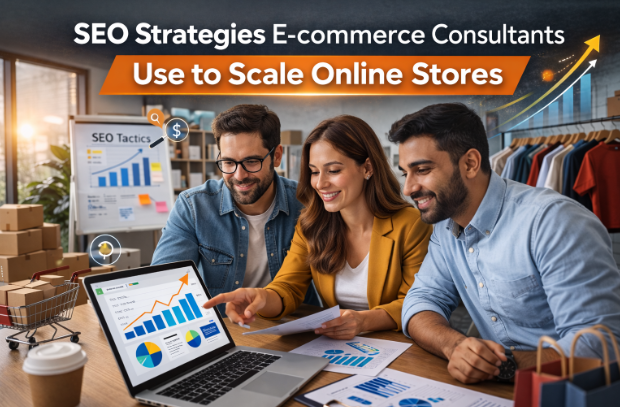
SEO Strategies Ecommerce Consultants Use to Scale Online Stores
Scaling an ecommerce store on platforms like Amazon, Shopify, WooCommerce, or BigCommerce isn’t just about adding more products or increasing ad spend. The most successful online retailers in the United States understand that sustainable growth requires a foundation of strategic organic visibility.
While paid advertising delivers immediate results, it’s organic search that builds long-term revenue without proportionally increasing costs. This is where an ecommerce SEO consultant becomes invaluable.
Unlike generalist marketers, ecommerce SEO specialists understand the unique challenges of online store platforms managing large product catalogs, handling inventory fluctuations, and balancing SEO with conversion optimization.
Here are the proven ecommerce growth strategies that top ecommerce professionals use to transform growing online stores into market leaders.
Strategy #1: Platform-Optimized Site Architecture for Scalability
Building a hierarchical information architecture within your ecommerce platform that logically connects collections to subcategories and individual product pages through strategic internal linking.
How It Scales Your Store:
Most ecommerce platforms auto-generate basic category structures, but an SEO ecommerce consultant customizes this architecture for search engine discovery. According to Semrush, sites with optimized internal linking see up to 40% improvement in page indexation rates.
For a Shopify store with 5,000 products, this means thousands more pages discoverable by Google. Strategic architecture targets search intent at every level. Main collection pages capture broad keywords like “women’s athletic shoes,” while filtered subcategories target specific attributes like “women’s trail running shoes waterproof,” creating multiple entry points for shoppers.
Strategy #2: Advanced Keyword Clustering
Grouping semantically related keywords into clusters and building comprehensive collection pages that target entire keyword families rather than single terms.
How It Scales Your Store:
Instead of creating separate Shopify collections for “yoga mats,” “best yoga mats,” and “yoga mats for beginners,” ecommerce SEO consultants develop one authoritative collection optimized for the entire cluster. They leverage platform features, collection descriptions, meta fields, and smart filtering to create content-rich pages.
Data from Ahrefs indicates that top-ranking ecommerce pages rank for an average of 1,000 related keywords, not just their primary target term. This multiplies organic visibility exponentially with each optimized collection.
Strategy #3: Technical SEO Automation
Implementing automated systems that maintain technical health across massive product catalogs on platforms like Shopify or WooCommerce without manual intervention.
How It Scales Your Store:
Ecommerce platforms generate thousands of URLs automatically for product pages, variants, and filtered URLs, creating technical challenges. Ecommerce SEO specialists configure dynamic title templates that automatically generate optimized metadata for new products, canonical tag rules to prevent duplicate content from variants, automated XML sitemaps prioritizing high-value products, and platform-specific apps configured for optimal performance.
According to Google, technical issues like poor site speed can reduce organic visibility by up to 60%. With US mobile commerce accounting for 44% of online sales, technical optimization directly impacts revenue potential.
Strategy #4: Strategic Content Hubs
Building blog and resource sections within your ecommerce platform that establish topical authority and capture earlier-stage traffic with clear pathways to product pages.
How It Scales Your Store:
An ecommerce SEO consultant strategically uses platform blog functionality to create content hubs, including comprehensive buying guides, product comparison articles linking to collections, use-case content addressing customer pain points, and FAQ pages answering pre-purchase questions.
Backlinko research shows that comprehensive content attracts 3.5 times more backlinks than shorter articles. For ecommerce stores, this authority flows through site architecture, improving rankings across product pages even without directly optimizing each one.
Strategy #5: Data-Driven Product Page Optimization at Scale
Using ecommerce platform analytics to prioritize which product pages to optimize based on conversion potential, profit margins, and ranking opportunities.
How It Scales Your Store:
A skilled SEO ecommerce consultant uses data to identify high-impact opportunities like products with high impressions but low click-through rates, best-sellers ranking on page two, and high-margin products with minimal organic visibility.
Ecommerce specialists leverage platform-specific features such as Shopify’s metafields, WooCommerce’s schema capabilities, focusing on descriptive product titles matching commercial searches, unique product descriptions avoiding manufacturer content, strategic product schema markup, optimized product images with descriptive alt text, and prominent customer review display.
Research from BigCommerce indicates that products with customer reviews see 270% higher conversion rates, making review optimization beneficial for both SEO and sales.
Strategy #6: Competitive Gap Analysis for Ecommerce Markets
Systematically analyzing competitor online stores to identify keyword opportunities, product gaps, and marketplace positioning advantages.
How It Scales Your Store:
Ecommerce SEO consultants focus on direct marketplace competitors selling similar products. They discover which product keywords competitors rank for that your store doesn’t, their highest-traffic collection pages, product categories they’re neglecting, and platform-specific advantages they’re leveraging.
This competitive intelligence is particularly valuable for smaller online stores competing against larger marketplaces. Independent Shopify stores can capture specific long-tail variations with better content and customer experience, where Amazon dominates broad terms.
Final Insights
These six strategies aren’t theoretical; they’re the operational playbook behind stores that consistently grow organic revenue quarter over quarter. But here’s what separates the stores that scale from the ones that stall: execution speed.
Every month you delay optimizing site architecture, fixing technical debt, or targeting high-intent keyword clusters is a month your competitors are compounding their organic advantage. You don’t need to figure this out alone.
eStore Factory has spent years building these exact systems for ecommerce brands across the US, turning underperforming ecommerce stores into category leaders through disciplined, data-driven SEO execution.
Your products deserve to be found by the people already searching for them. Let’s make that happen and start with a free organic growth audit and see exactly where the revenue gaps are.