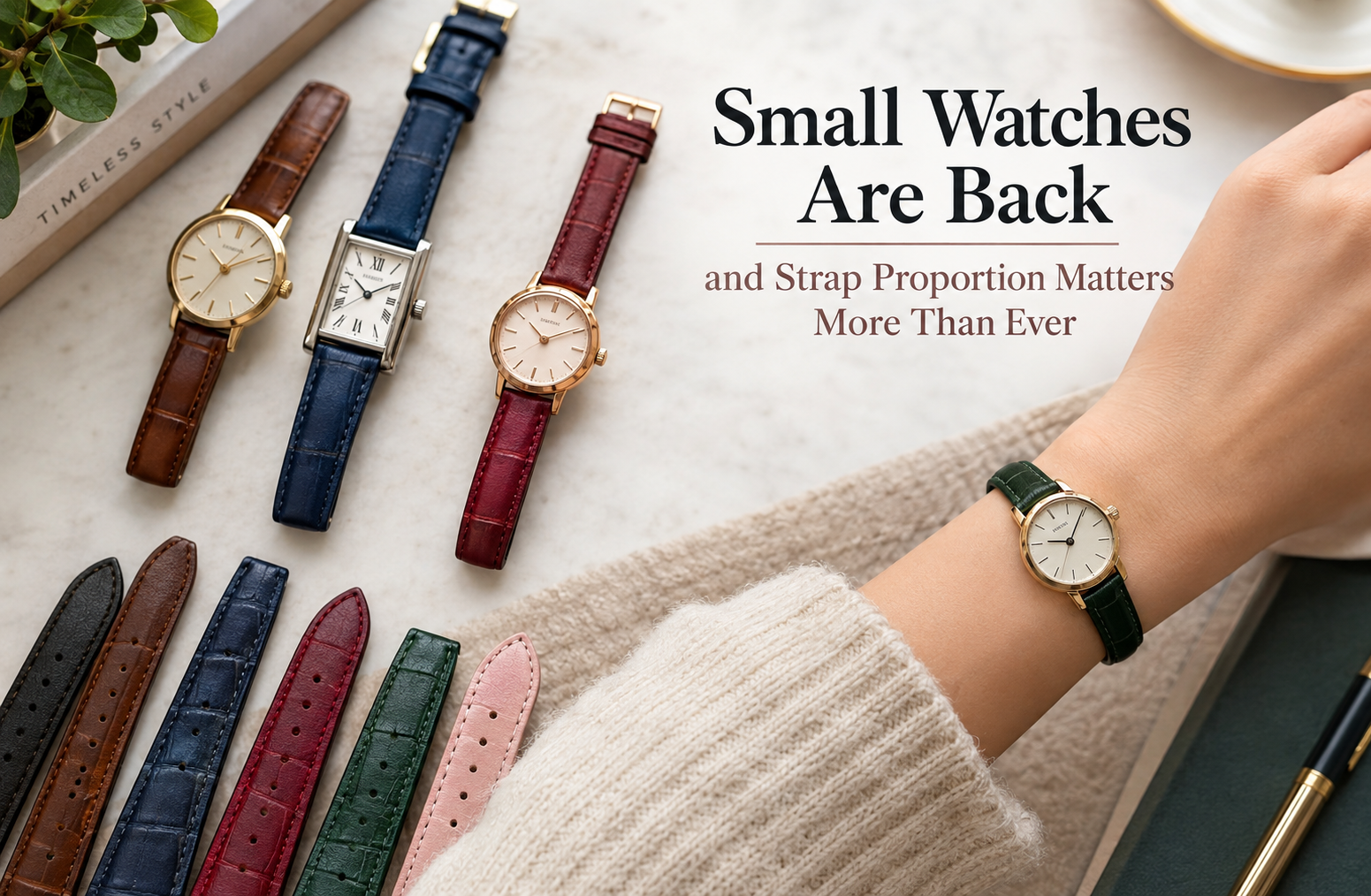
Small Watches Are Back and Strap Proportion Matters More Than Ever
Smaller watches have returned to the centre of fashion discussion in 2026. Compact round cases, rectangular designs and jewellery-style pieces are appearing as deliberate choices rather than old-fashioned alternatives to oversized watches. The shift also reflects how people wear watches alongside bracelets, shirt cuffs and everyday work clothes.
Case size may attract the attention, but the strap decides whether a small watch looks balanced on the wrist. Width, taper, padding, length and buckle size can either support the case or overpower it. For anyone bringing a petite watch back into use, proportion matters as much as colour.
Small does not mean one standard measurement
Two watches with similar case diameters can require different straps because their lug shapes and spacing differ. Rectangular cases also wear differently from round ones. The distance across the wrist, the length of the lugs and the way the strap drops away from the case can matter more than a single diameter figure.
The correct starting point is the lug width, measured between the inside edges where the strap attaches. Ladies’ watches often use narrower fittings, including 14mm, 16mm, 17mm and 18mm, but the actual case must be checked. Guessing based on the watch’s appearance can leave a gap or result in a strap that will not fit.
Proportion begins with width and taper
A narrow strap can look elegant on a compact case, but it still needs enough presence to hold the watch securely. Taper affects the visual line from the lugs to the buckle. A gentle taper often suits a dress watch because it keeps the fastening neat and prevents the lower half of the strap appearing heavy.
The dedicated Ladies watch straps collection from Watch Obsession brings together narrower leather options in different colours, textures and lengths. Brands listed include Hirsch, RIOS1931, Di Modell and Pebro, with calfskin, buffalo, alligator, crocodile, lizard and embossed alternatives represented across the range.
Padding can help or hinder a smaller case
Thick padding creates a pronounced curve and can suit a watch with a substantial case or raised bezel. On a very slim watch, the same construction may draw attention away from the dial and prevent the strap sitting naturally beneath a cuff. Flat or lightly padded leather often gives compact designs a cleaner outline.
Texture has a similar effect. Smooth calfskin keeps the appearance restrained. Fine grain adds interest without increasing the physical bulk. Large embossed patterns can work, but their scale should be considered against the available strap width. A pattern that looks balanced at 22mm may appear very different on a narrow design.
Stitching changes the proportion too. Tonal thread tends to keep the eye on the case and dial. Contrasting stitches outline the strap and can make it appear wider. Neither is automatically better. The choice depends on whether the strap should quietly support the watch or become a visible part of the outfit.
Length matters on every wrist
A small watch is not proof of a small wrist. Buying a short strap simply because the case is petite can place the buckle in the wrong position or leave too little tail to sit safely beneath the keepers. Measure a strap that already fits and compare both sections with the product details.
The watch should sit steadily on top of the wrist without needing to be fastened tightly. If the buckle pulls to one side, the balance between the long and short sections may be wrong. A correctly sized strap improves comfort and helps keep a compact case centred rather than allowing it to rotate.
Buckle scale should follow the taper. A wide or heavy clasp can dominate a narrow strap and feel awkward beneath the wrist. Anyone hoping to reuse the manufacturer’s original buckle should confirm the width at that end before ordering.
Colour can modernise a classic watch
Black and dark brown remain useful, especially for formal watches, but a small case can carry colour without taking over an outfit. Burgundy, navy, green, red, pink, purple and turquoise are among the shades listed in the Watch Obsession collection. The narrow area of a strap makes these colours easier to wear than a large matching accessory.
The dial provides a simple guide. A navy strap can relate to blue hands, while burgundy adds warmth to silver or cream. Tan can soften a gold-tone case. A black dial often accepts either a matching strap or a strong contrast. Exact matching is unnecessary, and slight differences can make the result look less forced.
Respect special fittings
Many traditional ladies’ watches use standard spring bars, but some bracelet watches and jewellery-led designs have integrated or unusual attachments. A normal straight-ended leather strap may not fit even when its width seems correct. Check the model and case construction before removing original parts.
Quick-release spring bars are convenient on compatible cases. Standard fittings can be changed with a spring-bar tool, although a jeweller or watch repairer is a safer choice when the lugs are delicate or access is restricted. The original bracelet, buckle and links should be stored together if the watch may later be returned to its earlier form.
The renewed interest in smaller watches is useful because it brings attention back to comfort and proportion. A petite case does not need an invisible strap, but it does need one chosen at the right scale. Careful measurement and an appropriate construction can make an older small watch feel entirely current.