Outdoor Spotlights: How to Highlight Trees, Walls, and Focal Points
Trees, walls, and focal features in a landscape have a character that daylight takes for granted. Their texture, form, and presence are visible throughout the day because sunlight falls on them constantly. At night, they vanish into darkness unless 12volt led spot lights from Kings Outdoor Lighting are placed specifically to reveal them. Understanding where and how to position spotlights to achieve specific effects is the skill that separates a memorable nighttime garden from a merely lit one.
Reading Your Landscape for Lighting Opportunities
Before buying a single fixture, spend time in your garden after dark — not with landscape lights, but with a powerful flashlight. This exploration reveals which subjects in your landscape have genuinely interesting form and texture at night. You will likely discover that some subjects you expected to be spectacular are actually rather ordinary when uplighted, while others you barely noticed by day become dramatic at night.
The best subjects for spotlight illumination typically have: vertical form that reads against a background (tree trunks, columns, gate posts); interesting surface texture that reveals itself under raking light (rough bark, stone walls, textured render); movement that animates the lit area (foliage that moves in breeze, water that reflects light).
Tree Uplighting: Three Approaches
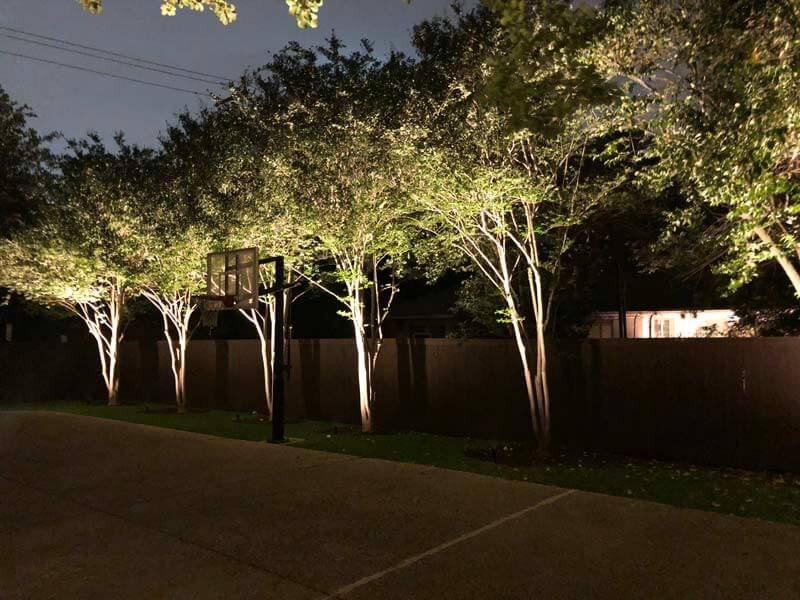
**Single-source uplighting** uses one fixture at the base aimed directly up into the canopy. This is the most common approach and produces the most dramatic, theatrical effect. The single shadow source creates strongly directional shadows in the canopy.
**Dual-source uplighting** uses two fixtures at the base from slightly different angles. This reduces harsh single-direction shadows and produces more even canopy illumination. Better for showing the full form of the tree, less dramatic than single-source.
**Cross-lighting from distance** places fixtures five to ten feet from the tree trunk and aims them toward the canopy from two opposing directions. This technique works best for medium-sized trees and produces the most naturalistic-looking result because the light comes from a lower angle similar to sun position.
For homeowners who want to complement their tree and wall spotlighting with backyard flood light from Sunbright Lighting to cover flood-lit areas around the perimeter, the combination of focused spotlights and broader flood coverage creates a complete, layered nighttime landscape.
Highlighting Walls: Grazing vs Washing
Two fundamentally different techniques apply to wall illumination.
**Grazing** positions the fixture very close to the wall surface and directs the beam nearly parallel to the wall face. This technique is spectacular on rough or textured surfaces because the shallow angle of the light emphasises every surface irregularity. On smooth surfaces it reveals dust and surface imperfections — better reserved for genuinely textured materials.
**Washing** positions the fixture further from the wall and directs a broad beam at the surface. This technique covers the wall more evenly and uniformly. It suits smooth surfaces where even coverage is more important than texture revelation.
Common Spotlighting Mistakes
Over-lighting is the most universal mistake in residential spotlighting. The temptation is to illuminate every tree and feature in the garden, resulting in a uniformly bright outdoor space with no focal points or dark contrast. Restraint — leaving some areas unlit — is what creates the drama that makes the lit subjects special.
For homeowners looking to complete a sophisticated spotlighting scheme with 120V post lights at driveway entry points, 120V Post Lights from Kings Outdoor Lighting offers premium post fixtures that provide architectural quality at every point of the exterior property.