Family Fitness: Fun Full Body Dumbbell Workouts
Strength training has evolved from a solitary gym pursuit into a shared family activity that builds both muscle and connection. Dumbbell workouts offer an accessible entry point for households looking to exercise together—requiring minimal equipment while delivering maximum results. These versatile tools engage multiple muscle groups simultaneously, making them ideal for families with varying fitness levels and limited time.
The appeal extends beyond convenience. Research from the Centers for Disease Control and Prevention shows that strength training twice weekly can reduce the risk of chronic disease while improving bone density, metabolic health, and mental well-being. When families train together, they’re not just building stronger bodies—they’re establishing patterns that can last generations.
Why Dumbbell Training Works for Every Family Member
Unlike fixed-weight machines or complex cable systems, dumbbells adapt to the user rather than forcing the user to adapt to them. This flexibility makes them particularly valuable for multi-generational fitness.
Key advantages include:
- Scalable resistance: A teenager and a grandparent can perform the same movement pattern with appropriately sized weights, making workouts truly inclusive.
- Functional movement patterns: Dumbbell exercises mimic real-world activities—lifting groceries, carrying children, moving furniture—translating directly to daily life.
- Space efficiency: A complete home gym fits in a closet, eliminating commute time and membership fees while increasing consistency.
- Injury prevention: The natural range of motion reduces joint stress compared to fixed-path machines, particularly important for growing bodies and aging joints.
- Shared accountability: When exercise becomes a family ritual rather than an individual obligation, adherence rates climb significantly.
The psychological benefits deserve equal attention. According to research published in the American Psychological Association, regular physical activity reduces anxiety and depression while improving self-esteem—outcomes that compound when experienced collectively rather than in isolation.
Building Your Foundation: Essential Equipment and Safety
Starting a family dumbbell routine requires more planning than simply ordering weights online. The right equipment matches your household’s current abilities while allowing room for progression.
For families starting their strength training journey, adjustable dumbbells provide the greatest level of versatility. Systems from manufacturers like Dumbbells.com, along with comparable options from Bowflex and PowerBlock, allow users to change weights quickly without filling a room with multiple pairs of equipment. While fixed-weight dumbbells can suit experienced lifters who already know their working loads, adjustable designs offer the flexibility needed for growing children and adults steadily increasing their strength.
Weight selection guidelines by age and experience:
- Children (8-12 years): Start with 2-5 pounds, focusing on movement quality over resistance
- Teens (13-17 years): Begin with 5-15 pounds, progressing as form solidifies
- Adults (novice): Women typically start with 8-15 pounds, men with 15-25 pounds
- Adults (experienced): Maintain multiple weight options ranging from 10-50+ pounds for different movement patterns
Safety protocols matter more in family settings than individual training. The National Strength and Conditioning Association emphasizes that proper supervision and age-appropriate programming prevent the vast majority of training injuries. Establish clear rules: no dropping weights, always use collars on adjustable dumbbells, and maintain adequate spacing between exercisers.
Create a dedicated workout zone with proper flooring—rubber mats protect both floors and equipment while reducing noise. Ensure adequate lighting and ventilation, particularly for high-intensity circuits that elevate heart rates quickly.
The 20-Minute Total Body Protocol
Time constraints represent the most common barrier to family fitness. This streamlined routine delivers comprehensive muscle engagement in less time than most families spend choosing a movie.
The workout structure:
- Dynamic warm-up (3 minutes): Arm circles, leg swings, torso rotations, and light cardio prepare muscles and joints for loaded movement
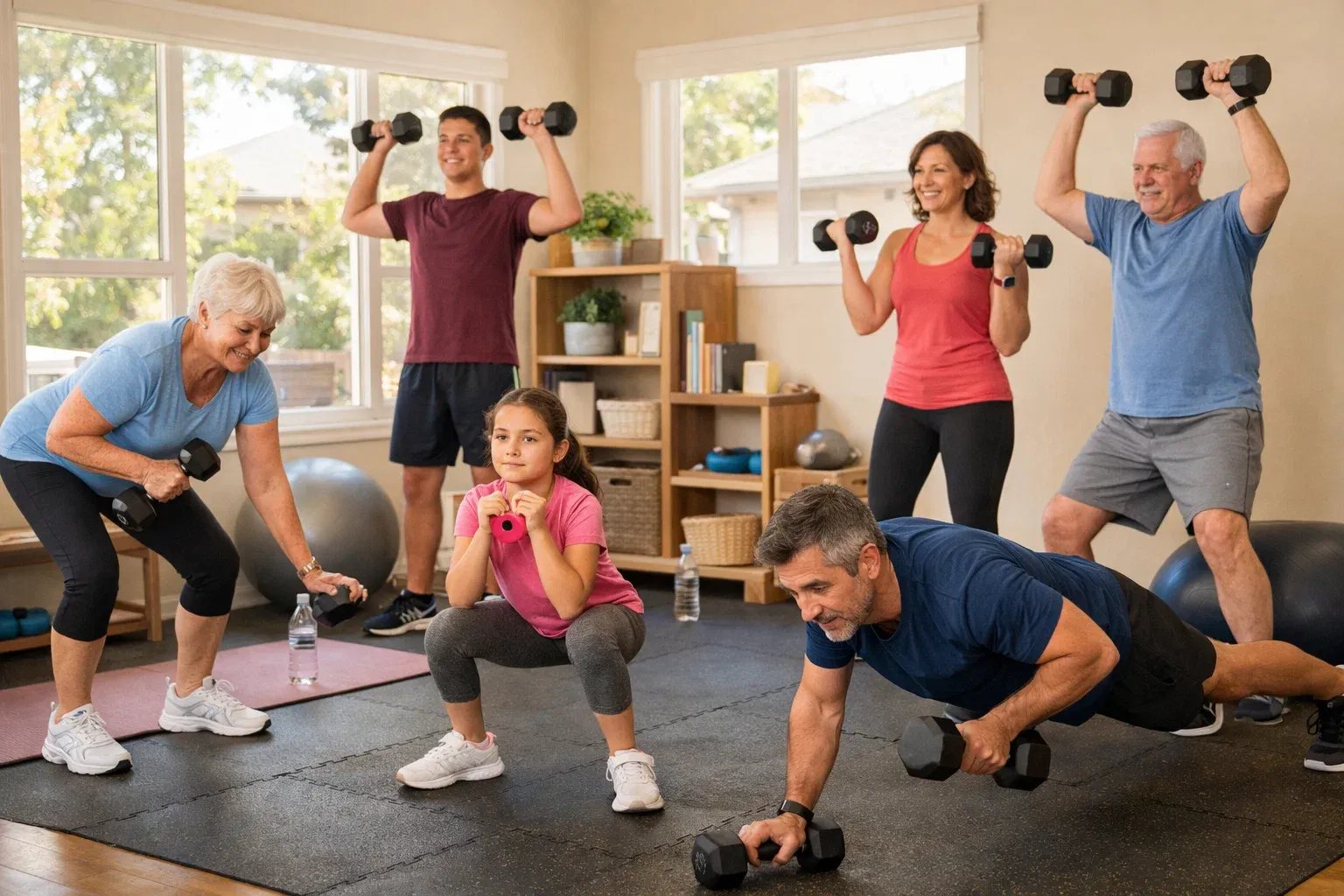
- Goblet squats (3 minutes): Hold a single dumbbell at chest height, descend until thighs reach parallel, drive through heels to stand—targets quads, glutes, and core
- Single-arm rows (3 minutes): Support one hand on a bench, pull dumbbell to hip while keeping back flat—builds lats, rhomboids, and rear deltoids
- Push press (3 minutes): Start with dumbbells at shoulders, dip slightly, then drive weights overhead using leg momentum—engages shoulders, triceps, and core
- Reverse lunges (3 minutes): Step backward into lunge position with dumbbells at sides, alternate legs—strengthens quads, hamstrings, and glutes while improving balance
- Hammer curls (2 minutes): Keep palms facing each other while curling dumbbells to shoulders—isolates biceps and forearms
- Plank with row (3 minutes): Hold plank position with hands on dumbbells, row one weight to hip while stabilizing with the other—challenges entire core plus back muscles
Repetition ranges should match individual capacity. Beginners perform 8-10 controlled repetitions per exercise, intermediate lifters aim for 12-15 reps, and advanced family members can push to 15-20 reps or increase weight instead. The goal is reaching near-fatigue by the final repetition while maintaining perfect form. Rest periods between exercises should be minimal—just long enough to transition and prepare mentally for the next movement. This approach maintains elevated heart rate, adding cardiovascular benefits to the strength stimulus.
Circuit Training: Maximum Efficiency for Busy Households
Circuit-style workouts eliminate the traditional rest periods between sets, instead rotating through different exercises that target different muscle groups. This allows one area to recover while another works, maximizing training density.
The metabolic advantages are substantial. Research shows circuit training can burn 30% more calories than traditional strength training while building comparable muscle mass—a significant benefit for families managing weight alongside strength goals.
Sample family circuit (repeat 3-4 rounds):
- Dumbbell deadlifts: 12 repetitions—hinge at hips, lower weights along shins, drive hips forward to stand
- Push-ups on dumbbells: 10 repetitions—elevating hands on dumbbell handles increases range of motion and wrist comfort
- Bent-over rows: 12 repetitions—hinge forward 45 degrees, pull both dumbbells to lower ribs
- Walking lunges: 10 steps per leg—hold dumbbells at sides, step forward into lunge, bring back leg forward into next lunge
- Plank hold: 30-60 seconds—maintain rigid body position from head to heels
- Russian twists: 20 total repetitions—sit with feet elevated, rotate torso side to side while holding single dumbbell
Between rounds, take 60-90 seconds to hydrate and reset. Younger children may need longer recovery periods, while conditioned adults can reduce rest to 45 seconds. The beauty of circuits lies in their adaptability—each family member works at their own intensity within the same timeframe.
Programming for Muscle Development
Families with muscle-building goals need to understand progressive overload—the principle of gradually increasing training stress over time. Without systematic progression, the body adapts to current demands and stops growing stronger.
Effective muscle-building exercises include:
- Romanian deadlifts: Keep slight knee bend, hinge at hips until dumbbells reach mid-shin, squeeze glutes to return—targets hamstrings, glutes, and lower back
- Overhead press: Press dumbbells from shoulder height to full arm extension overhead—builds deltoids and triceps
- Floor press: Lie on back, press dumbbells from chest to full extension—develops chest, shoulders, and triceps without requiring a bench
- Bulgarian split squats: Elevate rear foot on chair, lower into single-leg squat—intensely targets quads and glutes
- Bent-over reverse flyes: Hinge forward, raise dumbbells out to sides with slight elbow bend—strengthens rear deltoids and upper back
Structure muscle-building programs around 3-4 sessions weekly, allowing at least one rest day between workouts targeting the same muscle groups. Each exercise should involve 3-4 sets of 8-12 repetitions, with the final set reaching near-failure.
Track progress systematically. Maintain a shared family log noting weights used, repetitions completed, and how each session felt. When a family member completes all prescribed sets and reps with good form, increase weight by the smallest available increment—typically 2.5-5 pounds for upper body movements and 5-10 pounds for lower body exercises.
Younger family members should prioritize movement quality over weight progression. The American Academy of Pediatrics recommends that children and adolescents focus on learning proper technique with lighter loads before pursuing maximal strength development.
Nutrition Strategies to Support Family Training
Exercise stimulus represents only half the muscle-building equation. Without adequate nutrition, even the best-designed program produces disappointing results.
Protein intake deserves primary attention. Active individuals need approximately 0.7-1.0 grams of protein per pound of body weight daily to support muscle repair and growth. For a 150-pound adult, that translates to 105-150 grams spread across multiple meals.
Quality protein sources for active families:
- Lean meats: Chicken breast, turkey, lean beef, pork tenderloin
- Fish and seafood: Salmon, tuna, cod, shrimp
- Eggs and dairy: Whole eggs, Greek yogurt, cottage cheese, milk
- Plant proteins: Lentils, chickpeas, tofu, tempeh, quinoa
- Convenient options: Protein powder, protein bars, jerky
Carbohydrates fuel high-intensity training and support recovery. Contrary to popular misconceptions, active families need substantial carbohydrate intake—particularly around workout times. Focus on minimally processed sources like oats, rice, potatoes, fruits, and whole grain bread.
Hydration impacts performance more than most families realize. Even mild dehydration reduces strength output and increases perceived exertion. Establish a habit of drinking 16-20 ounces of water 2-3 hours before training, sipping during workouts, and consuming another 16-24 ounces afterward.
Pre-workout nutrition should emphasize easily digestible carbohydrates with moderate protein 1-2 hours before training. Post-workout meals should include both protein and carbohydrates within two hours of finishing exercise to optimize recovery.
Building Sustainable Family Fitness Habits
Equipment and programming matter less than consistency. The most sophisticated workout plan fails if it isn’t executed regularly, while even basic routines produce remarkable results when performed consistently over months and years.
Establish non-negotiable workout times just as you would important appointments. Many families find success with early morning sessions before daily schedules fragment attention, while others prefer post-dinner workouts as a shared wind-down activity.
Rotate exercise selection every 4-6 weeks to maintain engagement and prevent adaptation. The fundamental movement patterns—push, pull, squat, hinge, carry—remain constant, but specific exercises can vary widely. Goblet squats become front squats, rows become pull-ups, overhead presses become push presses.
Celebrate progress beyond the mirror. Track performance metrics like weights lifted, repetitions completed, or workout duration. Recognize improvements in daily activities—carrying groceries feels easier, playing with children requires less recovery, recreational sports become more enjoyable.
Most importantly, remember that family fitness represents an investment in shared health and connection. The weights you lift together today build strength that extends far beyond muscle—creating memories, establishing values, and demonstrating that taking care of your body is both important and achievable at any age.